What is Product Management and What Do Product Managers Do?

The world is changing. Product management is changing with it. The role of a product manager is evolving to meet the needs of today’s and tomorrow’s businesses. Let’s talk about what that means.
What Is a Product?
First, let’s define what a product is. Products come in many shapes and forms.
A product is a service or item created by a person or business to meet a customer need. Products can be physical, digital, or a mix of both.
You use products every day. Your clothes are products. Your desk chair is a product. Your team chat tool is a product. Zoom is a product. The learning platform you take courses on is also a product.
The type of product you work on directly shapes what your role looks like as a product manager.
What Is the Role of a Product Manager?
The product management role varies by company and by product. Even so, the core goal generally stays the same. Your job as a product manager is to create products that provide value by solving a real problem or meeting a real need.
To do this well, you need a strong understanding of your users. You also need to understand the market and the broader business context your product exists in.
You are responsible for the success of the product from launch and beyond, and sometimes this also means sunsetting a product because it no longer serves the organization. You align stakeholders across the business. You help define the product vision and direction. You set priorities. You make sure the team is building the right things at the right time, and you do this by balancing user needs, business goals, and technical constraints.
How the Product Manager Role Is Evolving
At the end of the day, most businesses care about two things: profitability and long-term viability. That has not changed.
What has changed is how your success as a product manager is measured.
In the past, much of your time went into roadmaps and feature delivery. You were often evaluated on how much work shipped and how quickly it shipped. Today, many of those tasks are automated or partially automated. AI tools can now support research, requirements drafting, competitive analysis, and testing.
Because of this, you have more time to focus on higher-value work. You spend more time deciding what should be built and why. You think more about tradeoffs. You decide which risks to accept and which risks to reduce.
The way you approach product strategy has also changed. Strategy still shows up in your daily decisions. Those decisions no longer need to live only in heavy planning documents. You can summarize learnings quickly. You can review data more easily. You can adapt faster when conditions change.
This shift creates space for learning. It creates space for better decision-making. It also raises the bar for what it means to be effective in the role.
Career Outlook
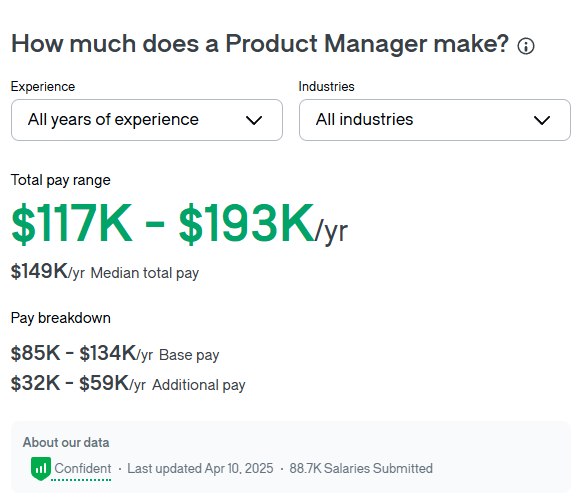
Product management continues to offer strong career outlook and earning potential. Salaries remain competitive across industries, especially as companies rely more on product-led growth and data-driven decision making. As you gain experience, you can grow into roles like Senior Product Manager, Principal Product Manager, or Group Product Manager. Many product managers also move into leadership paths such as Director of Product or VP of Product. Others transition into adjacent roles like product strategy, operations, or entrepreneurship. The skills you build in this role are transferable and remain in demand as technology and business continue to evolve.
If you want to understand whether product management is the right path for you and what your next steps could look like, you can book a call with our admissions team to talk through your goals and options.